
Introduction
When it comes to electric guitar tone, your amplifier head might get all the glory, but your speaker cabinet is the only thing really “making sound.”
The type of cabinet you choose can dramatically shape your sound — from transient response and bass response to spatial projection. This guide compares closed-back, open-back, and ported designs so you can choose with intent.
Why guitar cabinets are different
Before we explore each type, it’s important to understand that guitar speakers behave very differently from hi-fi speakers.
Home audio systems strive for linear, faithful reproduction. Guitar speakers thrive on non-linearity. Every voltage spike from your amp and percussive string attack feeds the complex, harmonically rich waveforms that define electric guitar tone.
That non-linear behaviour is exactly what we want — it's what makes electric guitars sound alive rather than clinical.
Closed-back cabinets
Construction
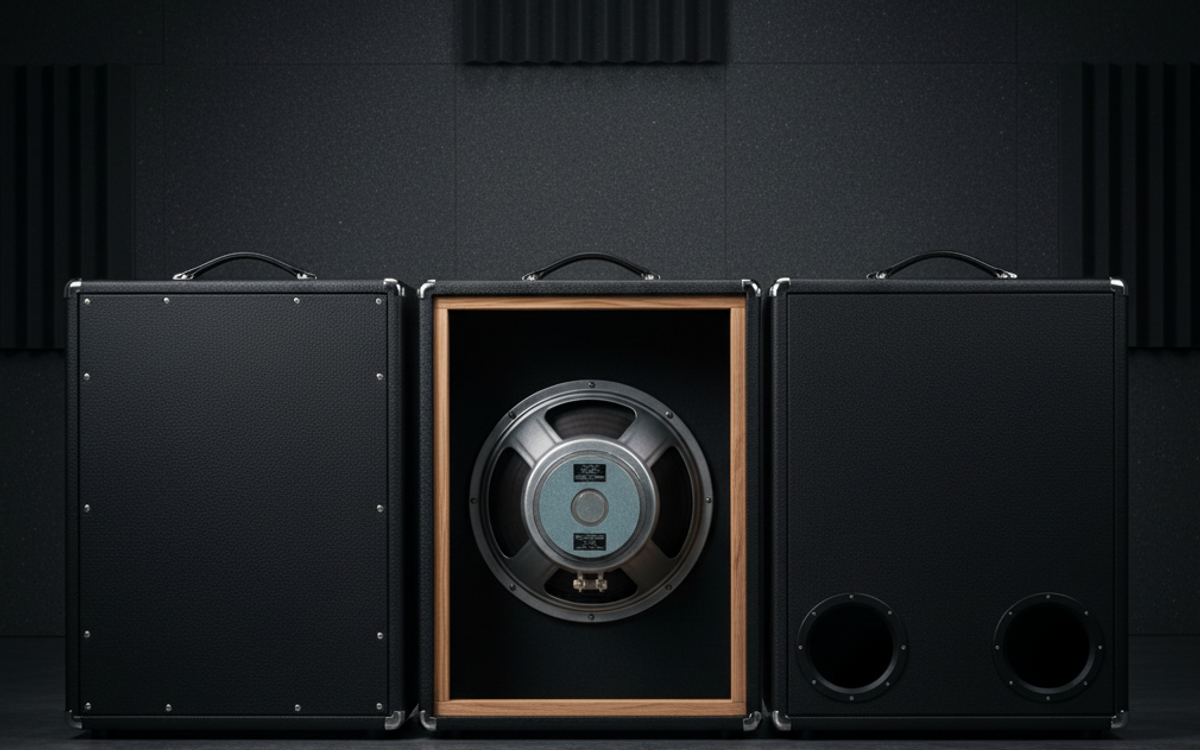
A completely sealed enclosure with no openings except for the speaker cone.
Sound characteristics
- Tight, punchy bass response: the sealed design creates a controlled environment that produces focused low-end
- Forward projection: sound fires directly at the audience with minimal dispersion
- Reduced feedback: less prone to unwanted feedback in high-volume situations
Pros
- Tight, controlled bass response
- Less prone to feedback
- Efficient use of amplifier power
- Consistent sound, less dependent on room acoustics
Cons
- Can sound boxy if not designed properly
- Less natural ambience and spatial character
- May emphasise harshness in bright amplifiers (especially if not designed carefully)
- Heavier than equivalent open-back designs
Popular examples
Marshall 1960 series, Mesa Boogie Rectifier cabinets, Orange PPC series.
Open-back cabinets
Construction
The back panel is either completely open or partially open, allowing sound to emanate from both front and rear.
Sound characteristics
- Airy, spacious tone: the open design creates a more three-dimensional sound
- Natural compression: lower efficiency means you push the amp harder for the same volume, so the power section adds its own compression — a softer, more forgiving feel
- Room interaction: sound reflects off nearby walls, creating natural ambience
- Reduced low-end: bass frequencies cancel due to phase interactions
- Sweet-spot playing: the sound changes with your position relative to the cabinet and the room
Pros
- Spacious, three-dimensional tone
- Natural compression and softer attack
- Creates natural room ambience
- Musical and organic sounding
Cons
- Less efficient
- Reduced bass response
- More susceptible to feedback
- Sound can vary significantly with room and positioning
- Phase cancellation can create unpredictable frequency response
Popular examples
Fender Blues DeVille combos, Vox AC30, many vintage-inspired combo amplifiers.
Ported cabinets
Construction
Features strategically placed ports (holes or tubes) that are precisely tuned to enhance specific frequency ranges.
Sound characteristics
- Extended bass response: ports can reinforce specific low frequencies
- Controlled frequency response when ports are tuned carefully
- Directional sound: like closed-back cabinets, most energy still projects forward — though side-mounted ports can let some escape off-axis
- Complex engineering: requires careful design to avoid unwanted resonances
Pros
- Extended bass response in targeted frequencies
- Maintains directional projection like closed-back designs
- Can provide “bigger cabinet” sound from smaller enclosures
- Controlled frequency response when properly engineered
Cons
- Often poorly implemented in guitar applications
- May emphasise frequencies that compete with bass guitar
- More complex to design properly
- Can introduce an unbalanced response if not well-tuned
- Limited availability of well-engineered options
The common challenge
Most ported guitar cabinets inherit their tuning from hi-fi, where the aim is a deep, extended low end. On guitar that same tuning tends to sound loose or one-note, and it pushes energy down below where the instrument really lives — instead of filling the 80–120 Hz dip where a typical guitar speaker actually needs help.
The speaker–cabinet relationship
Your speaker choice is just as important as your cabinet type. A bright, aggressive speaker in an open-back cabinet — or a dark speaker in a closed-back design — might not be the ideal pairing.
Consider these factors when pairing speakers and cabinets:
- Speaker sensitivity and power handling
- Frequency response characteristics
- Magnet type (ceramic vs. neodymium vs. alnico)
- Voice coil size and construction
Where the Rawrawk Quasar fits
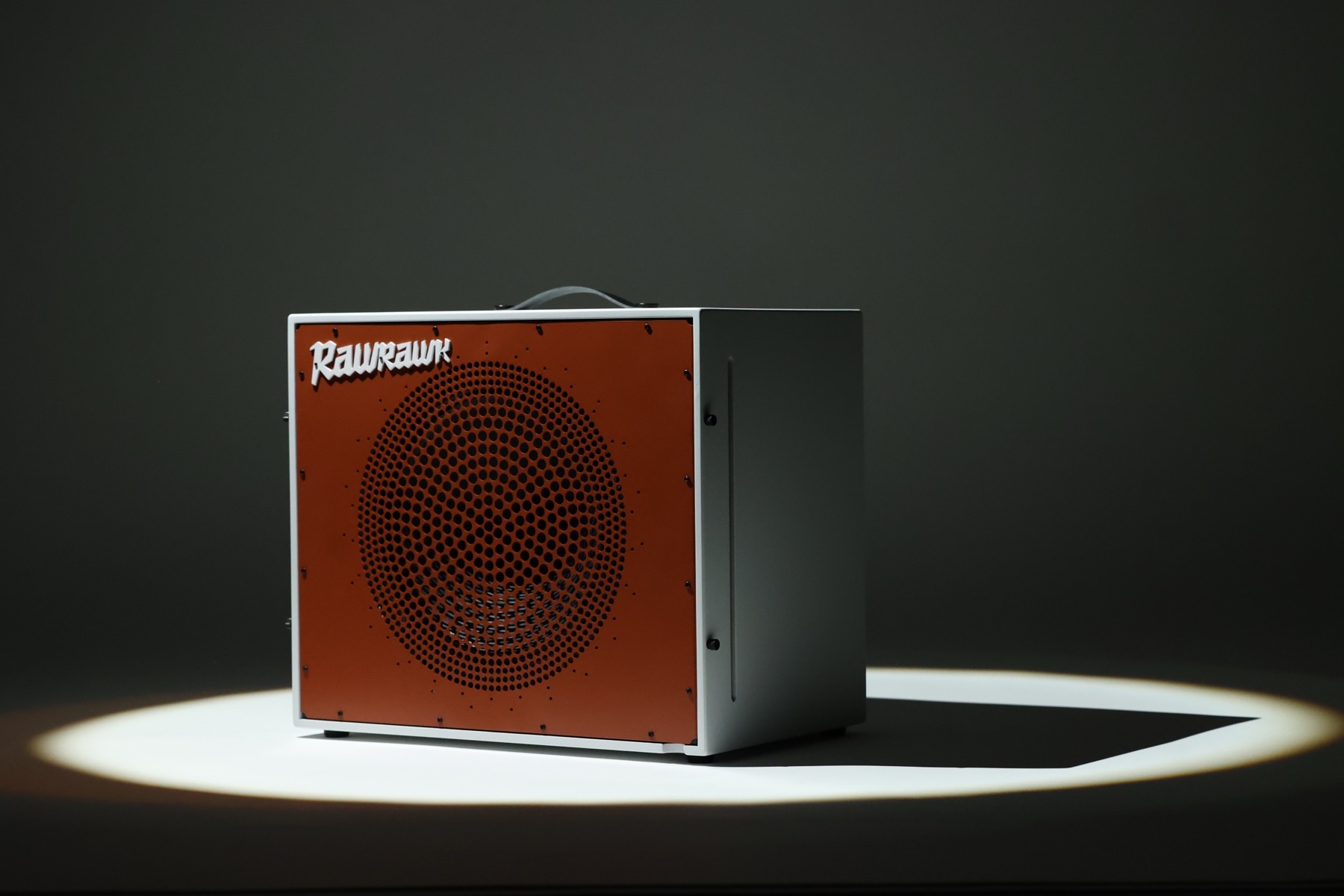
The Rawrawk Quasar is a guitar-specific take on the ported concept. Rather than simply borrowing hi-fi design principles, it was engineered around how guitar speakers actually behave.
The science behind the Quasar
Dual lateral ports are carefully tuned to the 80–120 Hz range — where many guitar speakers experience a natural dip in output. That avoids the common mistake of emphasising ultra-low frequencies that compete with bass guitars and get filtered out in professional mixes.
Advanced construction
- 9 mm Baltic birch plywood: strong structural and resonance characteristics at just 6 kg unloaded
- CNC interlocking joinery: panels lock together with high surface contact and rigidity, without screws
- Engineered bracing: acoustics and vibration design to minimise standing waves and unwanted resonances
- Impact-resistant finish: custom paint and ultra-matte varnish built for road use
Practical benefits
The design philosophy is “relatively neutral” rather than heavily coloured — so you can choose speakers without the cabinet dramatically rewriting your tone.
The dual ports provide the extended low-end response you’d associate with larger cabinets, while bracing keeps the sound tight for live and studio use.
Lateral port placement also adds a three-dimensional feel: some higher frequencies pass through, diffracting around the edges toward the listener.
In short, the Quasar bridges closed-back punch and open-back musicality — controlled bass extension without giving up directional projection.
The bottom line
Your cabinet choice is personal. It should complement your playing style, genres, and environments. Guidelines help, but the best test is still your guitar and amp under your fingers — and how the cab sits in a mix.
We designed the Quasar to bridge traditional categories: controlled bass extension from carefully engineered ports, without sacrificing the directional behaviour that works on stage. Relatively neutral by design — so your amp and speakers can shine.
Whether you prefer classic closed- or open-back cabs, or something that combines strengths from both, the goal is the same: a cabinet that inspires you to play and matches the sound you hear in your head.
After all, life’s too short for boring gear, right?