
Introduction
Digital modellers have become very popular — but they sound better with real guitar cabinets.
In 2025, guitarists have endless tone options: Helix, Kemper, Neural DSP, and similar tools pack hundreds of amps into a pedalboard or laptop. Yet many players still miss something when they go fully digital — that visceral, air-moving feel of a real speaker cabinet.
This piece digs into the science and practical upside of a hybrid setup: modeller into a real passive cab like the Quasar.
Digital modellers 101
Digital modellers simulate amps, pedals, and even cabinets using algorithms and impulse responses (IRs). They’re portable, consistent, and deep — great for silent practice, recording, and travel.
An IR is essentially a photograph of one cabinet's response — captured at a single moment and level, and fixed by definition. Hold that thought; it's why a real cab still has something to add.
To use a modeller with a passive cab like the Quasar (which has no power amp of its own), you typically need a power amp between the modeller’s line out and the speaker.
That chain drives real cone motion, combining digital flexibility with acoustic reality.
Advantage 1: Amp-in-the-room feel
Sound is nothing but air being moved — pressure waves reaching your eardrums — and a real guitar speaker moves it in a complex, non-linear way that headphones and many FRFR speakers only approximate.
IRs through headphones or FRFR (full-range, flat-response) systems capture a cabinet's colouration, but only that fixed slice of it — they don't recreate the physical, moment-to-moment interaction of a cone, a room, and your body on stage.
Speaker materials, cone breakup, and dispersion all contribute to how a cab “feels” in a room. Digital gets close — a real cab like the Quasar delivers the thing itself.
Advantage 2: Dynamic response and clarity
Speakers aren’t linear. They compress and distort under power, and their response keeps shifting with how hard the amp drives them and how far the cone moves. An IR can't follow that — being fixed, it treats every signal the same way no matter how hard you push. The living, level-dependent part of a real speaker is exactly what the snapshot leaves out.
Mixing engineers often tell us hybrid setups cut through live mixes more naturally, and there’s a mechanism behind it, not just taste: an EQ curve, like an IR, is fixed and linear, while a real cone’s dispersion and dynamics change with how hard it’s driven — work no static curve can fake.
Pair a cabinet like the Quasar with a modeller and you get versatile amp models with the dynamic honesty of moving air.
Advantage 3: Versatility without sacrifice
Digital modellers shine in consistency — fewer venue-to-venue surprises for amp settings and gain structure.
IRs remain excellent for direct-to-PA and silent stages. Hybrids add authenticity when the room needs a real source: modeller for the brain, passive cab for the body of the sound.
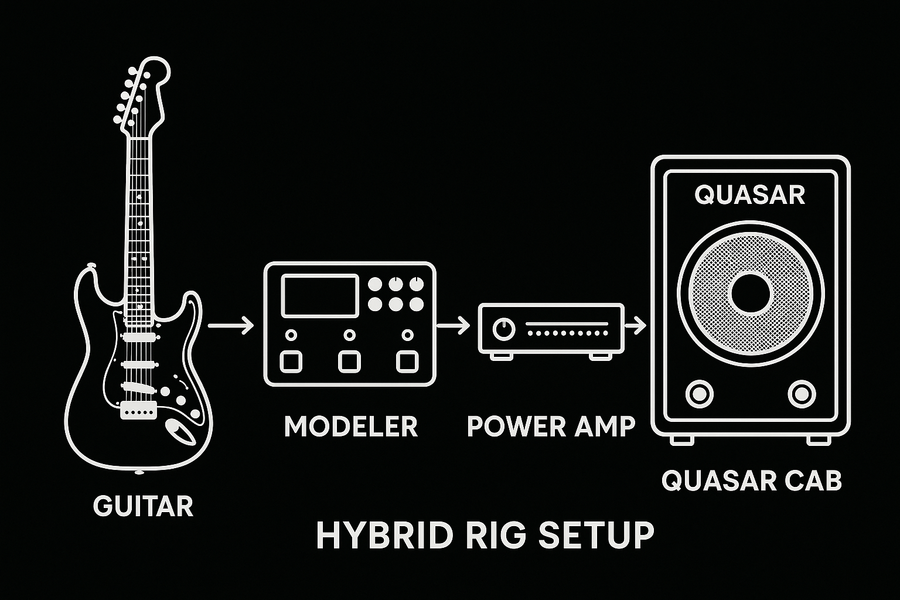
Tips for your hybrid setup
- Match power amp headroom to your cab’s rating and the volume you actually need
- Start with cab simulation off (or low) when feeding a real speaker — avoid double-cab colouration
- Use the modeller’s EQ lightly; let the Quasar’s acoustic design do part of the work
- Check stage volume early: hybrid rigs can get loud fast once a real cone is involved
- Keep a direct/IR path as backup for silent stages or FOH preference
The best of both worlds
Worth being clear on one thing, since we call the Quasar 'relatively neutral' elsewhere: neutral and dynamic aren't opposites. Neutral means the cab doesn't add colour, peaks, or artifacts of its own. It says nothing about the cab sitting still — it's a live acoustic system that responds differently as you dig in. Neutral in voicing, alive in feel.
Pairing digital with a real passive cab like the Quasar isn’t nostalgia. It’s a practical way to keep modern flexibility without giving up the physical response that makes guitar feel alive.
Tried it? Share your rig on Instagram (@rawrawkworld) or email us — we love hearing how players wire these systems.
— The Rawrawk Team